Getting-paid guides · 02
The money landed, then PayPal froze it for 180 daysThe real reasons a PayPal balance gets limited or frozen, how to appeal if it happens, and how to prevent it next time.
The notice turns up on an ordinary weekday and says almost nothing: your account has been limited. The balance is still there on screen, the client is quite sure they have paid you, and the one thing you cannot do is move any of it.
On this page
- Don't panic, and don't move more money in either
- What gives PayPal the right to freeze your money (it isn't a bank)
- Common triggers, see if one fits
- How to appeal, and what evidence to prepare
- What that "180 days" is really about
- What happens when the balance goes negative
- How to bring the freeze odds down next time
- When to cut your losses and switch lanes
- When you're frozen, don't believe these
- FAQ
- What to read next
01Don't panic, and don't move more money in either
The moment your account gets limited, the things you're most likely to get wrong are exactly the panic reflexes. Hold on to three "don'ts":
- Don't take new payments into this account. Letting more money flow in before the status clears just locks more of it up alongside the rest.
- Don't keep resubmitting the appeal over and over. Hammering the appeal repeatedly in a short window can read as unusual behavior to the system and actually slow things down.
- Don't close the account. Closing it won't get your money faster, and it can make funds inside a hold period harder to handle.
The first thing to actually do is open the official account limitation / resolution center and read exactly what it's asking you to provide; at the same time, screenshot your current balance, your transaction history, and your messages with the client and save them, because you'll need them for the appeal.
Before anything else, make sure the limitation is real. PayPal's help centre warns that if you get an email saying your account is limited but see no limitation in the Resolution Center, the email may be fake, and asks you to forward it to phishing@paypal.com. So leave the links in the email alone, open the PayPal app, and check the Resolution Center or the bell icon at the top of the page for the limitation.
02What gives PayPal the right to freeze your money (it isn't a bank)
Understanding this makes it sting a little less and tells you how to respond. PayPal is a payment intermediary, not a bank that holds your money. The user agreement you accepted when you signed up gives it the right to limit the account and hold funds based on its own risk judgment. Its machinery naturally leans toward protecting buyers and its own exposure, and as the one receiving money, you're on the more passive side.
So getting limited usually isn't because you did something badly wrong; it's that its risk model decided this payment, or this kind of payment, "needs another look." It isn't fair, but it's the rule, and the way through is to cooperate and provide evidence, not to fight it.
03Common triggers, see if one fits
Check whether anything you did recently matches one of these; it helps you figure out what materials to prepare:
- A new or dormant account suddenly receives a fairly large amount.
- The amount, frequency or source country of incoming payments suddenly looks very different from before.
- A buyer opened a dispute, a refund or a chargeback.
- The account name, address and bank info don't line up with your verification details.
- It judges you to be running business income through a personal account, with details that don't match.
PayPal's help centre sorts the reasons for a limitation into a few groups. The one closest to freelance work is higher-risk seller activity: an unusually high number of claims and chargebacks, suddenly selling an entirely new type of product, or sales volume that climbs fast and out of line with your usual pattern. A job several times bigger than normal falls into that last group. The others are possible unauthorized use of the account, regulatory requirements, and breaches of the Acceptable Use Policy; an account that has seen little use since sign-up can be limited too.
04How to appeal, and what evidence to prepare
The heart of an appeal is this: through official channels, in one go, plainly hand over the full set of materials so they have no reason to keep doubting this payment. The materials you'll commonly be asked for include:
- ID documents and proof of address.
- Your contract or order and invoice with the client.
- Proof of delivery (email exchanges, delivered files, project links).
- A short explanation of what your business does and what this payment was for.
- Log in and open the official Resolution Center, then find the notice tied to this limitation.
- Upload materials item by item against the checklist it shows, all at once, don't drip-feed them in several rounds.
- Keep all communication inside the platform's official channels, and don't hire a third-party "unfreezing" service; that's high-risk and may well be a scam.
Don't count on a phone call either. PayPal says that in most cases its customer service team cannot remove a limitation over the phone, and that you should wait for it to contact you; the proof of identity it asks for is uploaded in the Notifications Center after you log in.
05What that "180 days" is really about
The "180 days" many people hear about refers to funds being held / frozen for a period, meant to cover the window in which a buyer might open a dispute. It's alarming, but separate two things: being "limited" can usually be cleared through an appeal, while funds that are "held" may genuinely take a long cycle before you can touch them. In other words, it doesn't mean the money is gone for good, but you should brace yourself for a possibly long wait and not park your entire cash flow in this one account.
06What happens when the balance goes negative
A negative balance catches people out even more than a freeze. Of the causes listed on PayPal's US help page, three matter most for freelancers: a buyer opened a dispute and your balance could not cover it; the client charged the payment back through their card issuer; or a payment not covered by Seller Protection was taken back. The usual story is that the money went to your bank weeks ago, then a chargeback arrives and the account drops below zero.
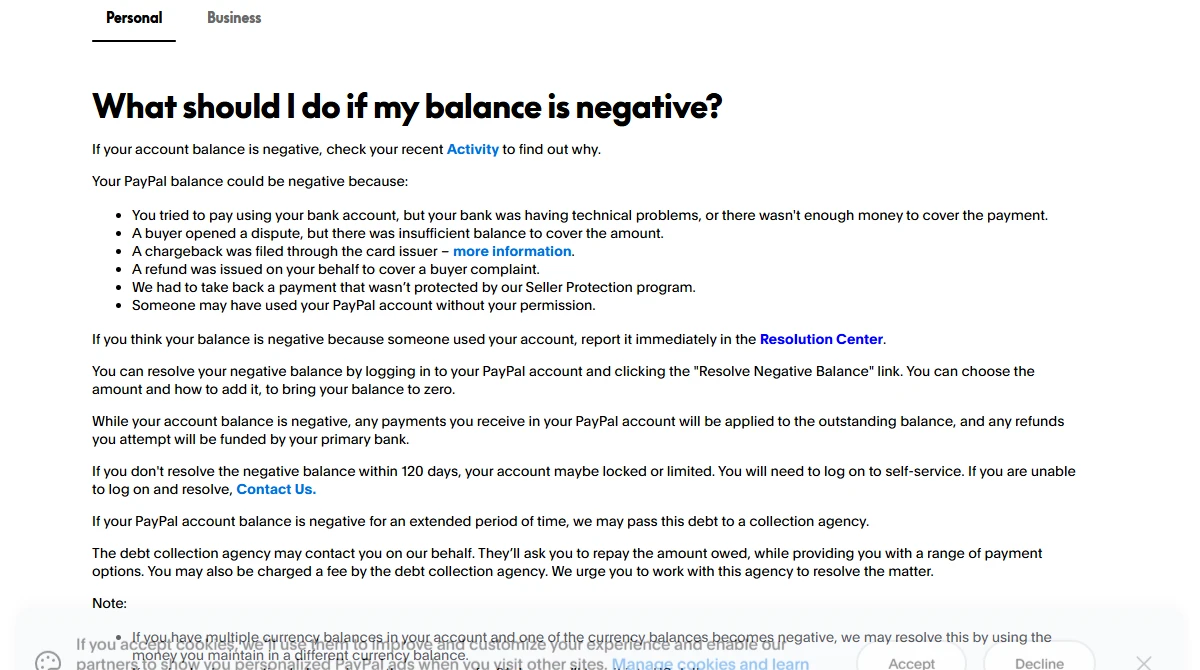
The same page is specific about what happens while the balance is negative:
- Every payment you receive goes to the shortfall first; you cannot touch it until the gap is filled.
- Any refund you send in the meantime is funded from your primary bank.
- If you hold several currencies and one goes negative, PayPal may cover it from another currency balance; a negative balance in a currency other than US dollars for 21 days gets converted into dollars.
- Leave it unresolved for 120 days and the account may be locked or limited; leave it longer and the debt may be passed to a collection agency, which may add a fee of its own.
The way out is to log in, use the Resolve Negative Balance link, and choose how much to add and from where until the balance is back to zero. Two things are worth knowing in advance. Disputes and chargebacks can arrive long after a payment, and having withdrawn the money does not stop the shortfall landing on your account. And while the balance is still negative, the next client payment disappears into it the moment it arrives, while the client assumes you have been paid. As for whether PayPal pulls money straight from your linked bank card, this page only mentions refunds being funded from your primary bank; user agreements differ by country, so for yours, open the Legal link at the very bottom of any PayPal page and find the section on amounts owed.
07How to bring the freeze odds down next time
- Keep your sign-up details, payee name and bank info consistent, and don't route through someone else's account.
- Grow income gradually; don't let a brand-new account take on a payment far above your usual.
- Keep contracts, invoices and delivery records for every job; with evidence in hand, appeals move faster.
- If your income is business-like by nature, consider spreading it across a channel friendlier to the one getting paid, and don't put all your eggs in one basket.
08When to cut your losses and switch lanes
Not every appeal succeeds quickly. If the funds enter a long hold and appeals keep going nowhere, rather than grinding yourself down endlessly, turn your energy to two more useful things: one, patiently wait out the hold period you have to wait out; two, switch to a channel friendlier to the receiver for your next payment. Treat it as a lesson, not a war you have to win.
09When you're frozen, don't believe these
Appeal a few more times and it gets unfrozen faster.
Resubmitting repeatedly in a short window can read as abuse. Following the official guidance and handing over the full set of materials once is usually more effective than racking up attempts.
Money PayPal freezes is never coming back.
Most of the time it's limited or held for a while; with complete materials and patient cooperation it can often be restored, though it really can be slow, so be ready for a long cycle.
Paying someone to "unfreeze" it gets the job done.
Services like that are high-risk and often scams, and can make your account problem worse. Clearing a limitation goes through official channels only.
10FAQ
My account got limited, is the client's payment still there?
Usually it's still in your account, just temporarily unavailable. Don't rush to have the client pay again; first read what the official notice is asking you to do.
Can I transfer to my bank while it's limited?
In most cases no, you have to wait until the limitation is cleared or the hold period ends. Taking more payments in during that time only locks up more money alongside it.
Should I just close the account?
Not advised. Closing it won't get you around the hold period and can make the funds harder to process.
If my balance goes negative, will PayPal take money from my bank card?
The US help page says incoming payments go to the shortfall first, refunds you send are funded from your primary bank, 120 days unresolved may get the account locked or limited, and longer than that may bring in a collection agency. User agreements differ by country; yours is under Legal at the bottom of any PayPal page.
Why does the limitation notice say so little?
PayPal emails you the reason for a limitation, but usually briefly. What it wants from you is listed after you log in, in the Resolution Center or under the bell icon at the top of the page.
11What to read next
If you're already thinking about switching to a channel friendlier to the one getting paid, read on:
- PayPal Help Center: Why is my PayPal account limited?
- PayPal Help Center: What should I do if my balance is negative?
Fees, rules and regional availability are whatever each official page shows in real time.