Getting-paid guides · 03
Wise or Payoneer: the cheaper one depends on how you get paidCompare the real take-home cost of both, by where your client is, the currency, amount and frequency.
You've opened both accounts. You have Wise, and you have Payoneer. So which one do you collect this invoice with? Online you'll find people swearing Wise is cheaper and others swearing Payoneer is easier, each sure they're right. No channel wins every time, though. Whether it's cheaper depends on where your client is, what they pay with, how big the amount is, and how often you collect. Change one of those and the answer can flip, so the verdict worth having is the one you get by running this invoice through both.
On this page
- Where the money comes from settles half of it
- The two collect money on totally different logic
- Match yourself to a "client type"
- Adjust again for amount and frequency
- What a $2,000 ACH payment costs on each
- The payment details each one gives your client
- Price the same invoice on both, side by side
- The hidden costs people overlook
- When neither one is the best fit
- Common misconceptions about Wise and Payoneer
- FAQ
- What to read next
01Where the money comes from settles half of it
- The client transfers to you themselves from a bank or card, and you value a clear statement: Wise is cheaper in most cases.
- Your money comes from a platform or marketplace batch payout, or the other side also uses Payoneer: Payoneer is often smoother and cheaper.
That is only the rough direction; for your invoice, the numbers further down decide it.
02The two collect money on totally different logic
They aren't "the same thing, one slightly cheaper". They're two different ways of collecting money, and the cost hides in different places.
| Dimension | Wise | Payoneer |
|---|---|---|
| Receiving itself | Gives you local receiving details in each currency | Gives you a receiving account that fits platform payouts smoothly |
| Exchange rate | Close to the mid-market rate, transparent | A spread applies on conversion |
| Main cost | A clearly stated fee on a tiered scale by amount | Withdrawal, conversion and account-related fees |
| Statement | Every item is visible | You have to total up each step yourself |
| Best for | Client transfers manually, you value transparency | Platform / marketplace batch payouts |
Wise puts the cost out in the open and keeps the loss thin with a rate close to the mid-market; Payoneer fits best when the money comes from a platform, but you have to add up withdrawal and conversion together to see its cost.
03Match yourself to a "client type"
- The client transfers to you manually (bank / card): Wise's local receiving details plus its transparent rate usually work out cheaper.
- The money comes from a platform or marketplace batch payout: Payoneer is often the method the platform supports by default, so it connects smoothly and receiving itself is low-cost.
- The other side is also a Payoneer user: moving money between Payoneer accounts is usually the simplest.
04Adjust again for amount and frequency
Once you've picked a direction, fine-tune with these three points:
- Small payments get hammered by the flat fee. The smaller the amount, the more that fixed fee weighs, so price it out first.
- Large payments get hit by the percentage and the rate. The bigger the amount, the more the FX spread and percentage fee pull the two apart, and a transparent rate has the edge.
- High frequency means watching the monthly total. With frequent small payments, a tiny per-payment gap adds up over a month; while you're at it, factor in how arrival speed affects your cash flow.
05What a $2,000 ACH payment costs on each
Take the most common case. You live outside the US, and a US client pays you $2,000 by ACH, the ordinary domestic bank transfer inside the US. Both services can give you a set of US-dollar receiving details, and the client's side looks almost identical. The difference shows up in the receiving step.
| Step | Wise | Payoneer |
|---|---|---|
| Where the client pays | Your Wise USD account details | Your Payoneer USD receiving account |
| Receiving | ACH payments are free to receive | The account currency isn't your local currency, so 1%, minimum 1 USD: $20 |
| Converting and paying out to your bank | One step: converted at the mid-market rate with a conversion fee you can see by entering the amount and currency on the pricing page | Converted at a wholesale market rate that includes the conversion fee; withdrawing to a local bank has its own fee, listed by country and currency on the pricing page, with the exact figure in the Fees section of your account |
On the receiving step alone, the same payment leaves you $20 lighter on Payoneer. Converting and paying out cost money on both, and how much depends on the currency and the country you withdraw in, so that part has to be priced on each site with the same amount.
Two situations flip the answer. If you are based in the US, dollars are your local currency, and a Payoneer receiving account in your local currency is free. And if the money comes from a platform already connected to Payoneer, or the payer also uses Payoneer, payments from another Payoneer balance are free, while platform payouts vary by platform.
06The payment details each one gives your client
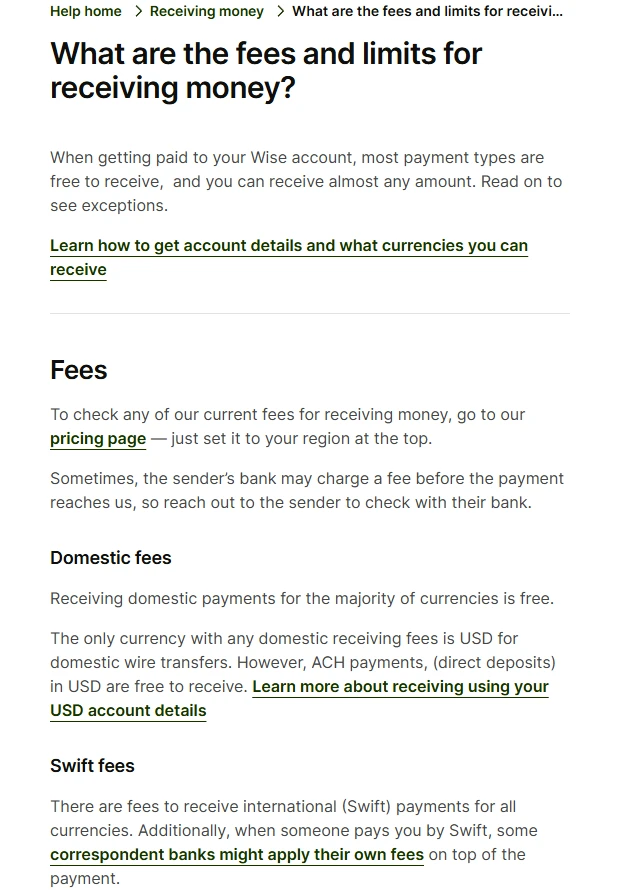
Both hand you something called a USD receiving account, but how the client pays into it changes the cost a lot:
- Wise USD account details: ACH transfers within the US are free; a domestic US wire carries a receiving fee; a Swift payment from outside the US carries a fee in every currency, and correspondent banks may deduct their own (see the section on wires in the delayed-payments guide).
- Payoneer receiving account: free when the account is in your local currency, 1% with a 1 USD minimum when it isn't.
- Payoneer payment request: you send a link and the client pays on it. By credit card or PayPal, the pricing page says up to 3.99% plus 0.49 USD; by US ACH bank debit, or from an EU or UK bank account, 1%.
So when you tell a US client how to pay, name the method as well as the account, for example "please send this by ACH from your US bank account to the details below", rather than just pasting numbers. If the client would rather use a card and you are on a Payoneer payment request, build that 3.99% plus 0.49 USD into the quote in advance, as in the pricing guide. How to send the details as a whole is covered in the guide on payment details.
07Price the same invoice on both, side by side
- Open Wise's pricing / rate calculator, enter this invoice's amount and currency pair, and note "you get".
- From Payoneer's fees, estimate the receiving fee + conversion + withdrawal, and remember to count the step of withdrawing to your local bank too.
- Put the two "you get" figures side by side. Then weigh in arrival speed and your cash-flow needs, instead of chasing a difference of a few dollars.
Running it once with your own numbers beats any sweeping "which is cheaper" verdict, because the answer genuinely differs from person to person.
08The hidden costs people overlook
- Annual or monthly fees on a physical card or account.
- Fees that long inactivity can trigger.
- The fee for withdrawing cash from an ATM with the card.
- The extra conversion loss from routing through one more currency.
- Minimum withdrawal limits that strand small amounts in the account.
09When neither one is the best fit
In some situations, neither is the best answer:
- When the client will only use PayPal, locking down the freeze risk matters more first.
- When your local fiat rails are slow and expensive, USDT may be faster and cheaper, but you carry the risk yourself.
- When the amount is large and both sides have suitable local banks, a direct wire transfer is sometimes the more straightforward route.
10Common misconceptions about Wise and Payoneer
Wise is always cheaper than Payoneer.
It depends on how the money arrives and where you withdraw it. In platform batch-payout scenarios, Payoneer is often both cheaper and less hassle.
Payoneer receives money for free, so it costs nothing.
The cost hides in withdrawal, conversion and account-related fees. What you need to total is the full trip from "client pays" to "spendable local money".
11FAQ
Is it a problem to keep both accounts open?
Generally not. Many people split them by client type: platform payouts go through Payoneer, manual client transfers go through Wise.
The client says the fee is high, can I get them to switch?
You can politely suggest a channel that's transparent for both sides, and send your receiving details neatly so there's less back-and-forth.
Which one arrives faster?
It depends on the channel and region; there's no single answer. The most reliable way is to try a small payment through each and note the actual arrival time.
A US client pays in dollars by ACH. Is Wise or Payoneer cheaper to receive on?
On the receiving step alone, ACH into Wise USD account details is free, while a Payoneer receiving account that isn't in your local currency charges 1%, minimum 1 USD. Converting to your local currency costs money on both, so price that step with the same amount on each.
The client wants to pay by credit card. Can I use Payoneer for that?
You can send a Payoneer payment request that the client pays by card; the pricing page lists up to 3.99% plus 0.49 USD. Switch to a bank transfer if you can, and if you can't, build the fee into your quote.
12What to read next
Fees, rules and regional availability are whatever each official page shows in real time.