Getting-paid guides · 15
A US client wants a W-8BEN before paying youWhat the form certifies, which lines trip people up, why the treaty part is usually blank, and when you need to sign a new one.
The contract is signed, and then a note arrives from the client's accounts team: before the first payment goes out, they need a W-8BEN on file. The form is one dense page of withholding, beneficial-owner and treaty language, with a signature line under "penalties of perjury" at the bottom. It reads like a tax return, which is why so many people stall on it. It is closer to the opposite: a statement to the payer that you are not a US person, so they can pay you without holding tax back. It stays in their files, it does not go to the IRS, and on its own it creates no tax bill.
On this page
- What the form actually tells the payer
- Which form applies to you
- Part I, line by line
- Part II, and why most freelancers leave it blank
- The signature and the expiry date nobody reads
- Who should get your W-8BEN, and who shouldn't
- Six mistakes that get forms sent back
- No US withholding is not the same as no tax
- FAQ
- What to read next
01What the form actually tells the payer
A US company or platform that pays a foreigner is treated as a withholding agent. For some kinds of payment it has to hold back 30% as tax and send it to the IRS, and you get the rest. The W-8BEN is how it knows you are foreign. The IRS puts it bluntly: submit the form when the payer asks for it, whether or not you are claiming a reduced rate. The instructions add that if you don't, the payer may withhold at the 30% foreign-person rate, or at the backup withholding rate, currently 24%.
For remote work, a second rule does the heavy lifting. The IRS sources income from personal services by where the work is physically done, regardless of where the contract was signed, where the money is paid from or where the payer lives. Design, writing or code you produce outside the United States is foreign-source income, and a nonresident alien is generally taxed by the US only on US-source income. So the usual result of a correctly completed W-8BEN is that the fee is paid in full, with nothing held back.
02Which form applies to you
There are several W-8 forms, and their names differ by a letter or two. Send the wrong one and it comes straight back. Match yourself against this:
| Your situation | The form to send |
|---|---|
| You work as an individual, are not a US citizen or green card holder, and do the work outside the US | W-8BEN, the form this guide covers |
| You invoice and get paid through your own company | W-8BEN-E, the version for entities |
| You are a US citizen (even one who has lived abroad for years), a green card holder, or a US resident under the day-count test | W-9; none of the W-8 forms apply |
| You perform the services while physically in the US and want treaty relief from withholding on them | 8233 or W-4 |
| You run an actual business in the US and this income is connected to it | W-8ECI |
The third row is the one people get wrong. US citizenship follows the passport, not the address, so an American who has lived in Lisbon for a decade still sends a W-9. Dual nationals who hold a US passport are in the same position, and a green card counts until it has been formally given up.
03Part I, line by line
Part I is about who you are, across eight lines. Many platforms rebuild it as an online form with the same order, so this works for both:
| Line | What goes in | Watch out for |
|---|---|---|
| 1 Name | Your own name, spelled as on your ID | Keep it identical to the name on your receiving account; the payment step checks that name too |
| 2 Country of citizenship | Your nationality | Dual citizens enter the country where they are both a citizen and resident at the time |
| 3 Permanent residence address | Your home address in the country where you are resident for tax | No P.O. box, no in-care-of address, no bank's address; street on one row, city, region and postcode on the next, country on its own |
| 4 Mailing address | Only if it differs from line 3 | Otherwise leave it empty |
| 5 US taxpayer identification number | SSN or ITIN | Most people who never worked in the US have neither; leave it blank unless a treaty claim calls for one |
| 6a Foreign tax identifying number | The tax number your country of residence gave you | For example a PAN in India, a UTR or National Insurance number in the UK, the resident ID number in mainland China |
| 6b Checkbox | Tick only if your country does not legally require you to have a tax number | If you have one, leave it unticked |
| 7 Reference number(s) | Only if the payer gave you one | Usually empty |
| 8 Date of birth | Month first: MM-DD-YYYY | 5 March 1990 is 03-05-1990; the most common slip on the whole form |
Line 6a is where people hesitate. The instructions make it mandatory when you are documenting yourself as the holder of a financial account. A form given to a client purely so they can pay your fees is not strictly in that category, yet plenty of platforms make the field compulsory anyway. If you have a tax number, filling it in costs nothing and avoids a rejected form.
04Part II, and why most freelancers leave it blank
Part II is the treaty claim: it asks the payer to withhold at a lower treaty rate. That only means something if the payment would be taxed by the US in the first place. Fees for work done outside the US are foreign-source and not withheld on, so there is nothing for a treaty to reduce, and the section stays empty.
The internet is full of walkthroughs that tell you to put your country on line 9 and some article number with a 0% rate on line 10. For service fees that is redundant, and a wrong article or rate can earn you a follow-up question from the payer. The instructions keep line 10 narrow as well: it is only for treaty conditions that line 9 and the Part III certification do not already cover.
The case where Part II does matter is a different kind of income. Royalties from a US stock-media library, font marketplace or e-book platform, if they count as US-source, are withheld at 30% by default, and many tax treaties set a lower rate for royalties. Then line 9 names your country of residence and line 10 cites the treaty article, rate and conditions as the treaty itself words them. If you are unsure of the article, pick from the options the payer's system offers, or ask a tax professional rather than guessing.
05The signature and the expiry date nobody reads
Part III is the certification: you confirm the details are true, that you are the beneficial owner of the income, and that you are not a US person. Sign in your own name and date it month first, as on line 8. On a platform, ticking the confirmation box and typing your name is the electronic signature; the 2021 instructions added guidance on e-signatures, so if the payer's system supports one, it is fine.
The expiry is the part hardly anyone notices. A W-8BEN runs from the day you sign it to the last day of the third calendar year after that one. Sign on 13 September 2026 and it is good until 31 December 2029. Near the end, the platform or client will email you for a fresh one; treat that email as real, because an expired form can be handled as no form at all, and the next payment may be withheld on.
Changes to your circumstances bring that date forward. The instructions require you to tell the payer within 30 days of a change that makes the form wrong, and to give them a new form. The usual triggers are moving to another country, becoming tax resident somewhere else, or switching to a US address.
06Who should get your W-8BEN, and who shouldn't
Put your full name, home address, date of birth and national tax number on one page and you have a complete identity kit. Before you send it, be sure who is asking:
- A freelance platform: fill it in on the platform's own tax information page, not by email.
- A direct client under contract: use the e-signature link their finance team sends, or send the completed PDF to the address you already deal with for payments.
- A recruiter you have only chatted with on a messaging app, with nothing signed: hold off. Asking for a W-8BEN plus a photo of your ID as part of onboarding is a well-worn identity-theft script.
Each payer keeps its own copy and platforms do not share them. Having filed one on a platform does not cover a direct client who asks; they get their own.
07Six mistakes that get forms sent back
When a form bounces, or a payment turns up short months later, the cause is usually one of these:
| The mistake | What happens | The fix |
|---|---|---|
| Date of birth written day first | Validation fails, or it no longer matches your ID | Always MM-DD-YYYY |
| A business, mail-forwarding or P.O. box address on line 3 | The form may be treated as invalid | Your home address in your country of tax residence |
| Treaty article copied into Part II | Follow-up questions, or the form comes back | Leave Part II empty for service fees |
| Name differs from the receiving account | The payment fails the name check and stalls on their side | Match the name order and spacing to the payment details you give clients (see guide 7) |
| A green card or US passport holder sending a W-8BEN | A false status statement made under penalties of perjury | Send a W-9 instead |
| Moved country and never updated it | The form no longer holds | Tell the payer within 30 days and send a new one |
08No US withholding is not the same as no tax
A W-8BEN settles one question: whether the US holds tax back from this payment. It says nothing about what you owe where you live, and it does not make the money tax-free.
Most countries tax their residents on what they earn, wherever the client happens to be, and some source service income the same way the US does, by where the work is done. China is one of them: work done at home for a US client counts there as income from services performed inside China, whoever pays it. Because nothing was withheld at source, the whole fee reaches you gross, and whatever tax is due on it at home is yours to report, usually on your own, since a foreign client withholds nothing for your tax authority.
The practical side is the same everywhere: keep the invoice, the arrival record and the exchange rate you used for every payment, so the numbers are ready when you file. The records guide sets that up in one spreadsheet. How your country treats the income, and when you declare it, is a question for a local tax professional or your tax authority.
09FAQ
Do I have to file a US tax return after submitting a W-8BEN?
The form itself creates no filing obligation; it stays with the payer and never goes to the IRS. A nonresident alien who does the work outside the US and has no US-source income generally has nothing to file with the IRS.
The platform says it will withhold 30% until I submit the form. Is that real?
Yes. The instructions say that not providing a W-8BEN when asked may lead to withholding at the 30% foreign-person rate or at the backup withholding rate. A correctly completed form usually brings withholding on remote service fees down to nothing.
I'm a US citizen living abroad. Can I use a W-8BEN?
No. US citizens use Form W-9 wherever they live, and so do green card holders and anyone who meets the substantial presence test.
Can I reuse the form I gave one platform for a different client?
Each payer keeps its own. The one you completed inside a platform lives in that platform's system; for a direct client, fill in a separate form in whatever way they send it, with the same details.
Can I sign it electronically?
Yes. The 2021 instructions added guidance on electronic signatures, so a platform's online form or an e-signature link from the client is fine, as long as their system supports it.
10What to read next
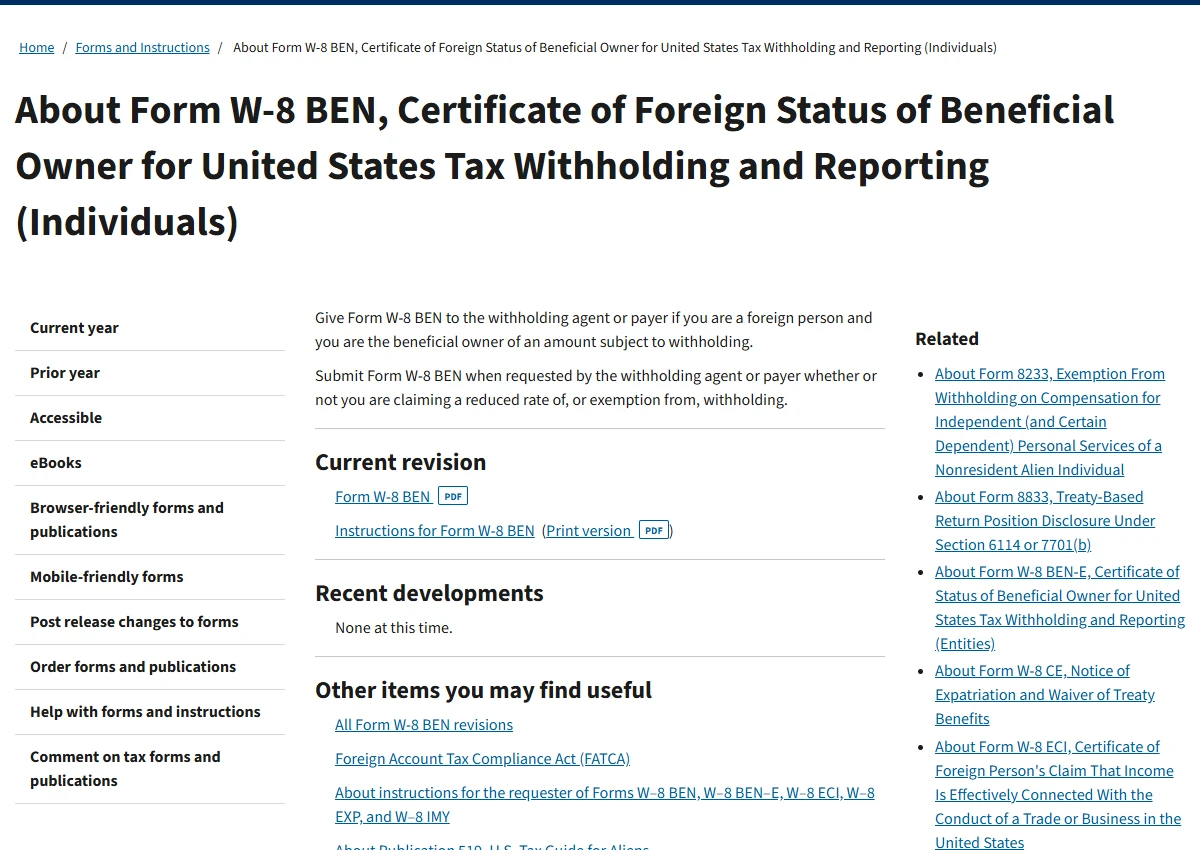
- IRS: About Form W-8 BEN
- IRS: Instructions for Form W-8BEN (October 2021)
- IRS: Source of income, personal service income
- China's Ministry of Finance and State Taxation Administration: announcement on individual income tax for foreign-source income (in Chinese)
Forms and instructions get revised; check the version listed under Current revision on the IRS page before you fill one in.