Getting-paid guides · 16
The due date has passed and the client has gone quietWhat to do and say from day one to day sixty of a late invoice, and how to cut your losses if the money never comes.
The invoice was due last Friday. You gave it the weekend, checked your account on Monday and found nothing. You sent a quick message and got back "thanks, I'll check with finance", then silence again. At this point people usually go one of two ways. Some feel awkward asking twice and let it drift for two months. Others fire off an angry email and turn a client who was merely slow into one who no longer feels like paying.
On this page
- Make sure the hold-up isn't on your side
- A chasing schedule for the first thirty days
- Three chasing emails you can adapt
- Can you charge interest on a late invoice?
- When to stop working for them
- Platform jobs go through the platform
- What the law where your client is can do
- When the money isn't coming back
- FAQ
- What to read next
01Make sure the hold-up isn't on your side
Before you chase anyone, spend ten minutes on your own paperwork. A fair share of "late" invoices never entered the client's payment process at all, or the money is already on its way.
- Who the invoice went to. Plenty of companies only pay invoices sent to a finance or accounts-payable address, with a purchase order number on them. The copy you sent to the project manager may still be sitting in their inbox.
- Whether the invoice states a due date or payment terms, such as "payable within 15 days of receipt". If it doesn't, the client's finance team will usually slot it into their own default terms, and 30, 45 or 60 days are all common.
- Whether your payment details are right, and whether the money was sent and bounced. The guide on delayed payments covers how to check.
- Whether they are waiting on you: sign-off on the delivery, a W-8BEN for a US client, a supplier registration form nobody filled in.
If all four check out, the invoice is genuinely overdue, and the schedule below takes over.
02A chasing schedule for the first thirty days
| When | What to do | Tone |
|---|---|---|
| 3 days before the due date | A short reminder with the invoice attached again | In passing, not a chase |
| Day 1 overdue | First email: confirm they received the invoice and ask when it will be paid | Assume it slipped |
| Day 7 | Second email: copy in their finance or accounts-payable address and ask for a specific payment date | Polite but specific |
| Day 14 | A phone call or a ten-minute video call; pause any new work for this client | Say it directly |
| Day 30 | Third email: the amount owed, days overdue, contractual interest and a final deadline, in writing | Formal |
| Day 45 to 60 | A platform dispute, a government complaint channel or a collection agency; decide whether legal action is worth it | Facts only |
No law sets this timetable. It is one you set for yourself, so that you know when a reminder turns into a demand without agonising over it each time. Move the dates around to suit the amount and the relationship, but keep every step in writing. If this ends up on a platform or in front of a regulator, that trail is your evidence.
03Three chasing emails you can adapt
The three emails do different jobs: the first establishes the facts, the second asks for a date, the third spells out what happens next. Replace the parts in brackets, and attach the invoice again each time with the amount, currency and invoice number clearly shown.
Subject: Invoice [#023], due [12 September]
Hi [Anna], just checking that invoice [#023] for [USD 1,200] reached your accounts team. It was due on [12 September]. Could you let me know when it is scheduled for payment? I have attached the invoice again, with my payment details on the first page.
Thanks, [your name]
It only asks whether the invoice arrived. No blame, no consequences. A lot of invoices are stuck at the point where nobody forwarded them to finance, and an email like this is often all it takes to move one along.
Subject: Invoice [#023], now 7 days overdue
Hi [Anna] (cc [ap@client.com]),
Following up on invoice [#023] for [USD 1,200], which was due on [12 September]. I have not received payment yet. Could you confirm the date it will be paid? If anything is missing on my side, such as a PO number or a tax form, tell me and I will send it today.
Thanks, [your name]
Copy their finance team and ask for a date, not a vague "soon". Offering to supply anything that is missing takes away the easy excuse for another round of delay.
Subject: Invoice [#023], 30 days overdue, final reminder
Hi [Anna],
Invoice [#023] for [USD 1,200] is now 30 days overdue. Under our agreement, late payments carry interest of [1.5% per month], which brings the amount due to [USD 1,218]. Please arrange payment by [15 October]. If I have not received it by then, I will [open a dispute on the platform / pass the invoice to a collection agency]. I would much rather settle this directly with you.
[your name]
The third email names three things: what is owed, what the contract adds to it, and the deadline along with what you will do after it. Only name a next step you will actually take; an empty threat turns the email into one more reminder. If your contract says nothing about interest, delete that sentence rather than inventing a rate now.
04Can you charge interest on a late invoice?
Start with the contract. If it sets a late-payment rate, that is the rate. If it says nothing, it comes down to which country's law governs the contract and whether that law provides statutory interest, which usually covers business-to-business deals only. For the places clients most often are:
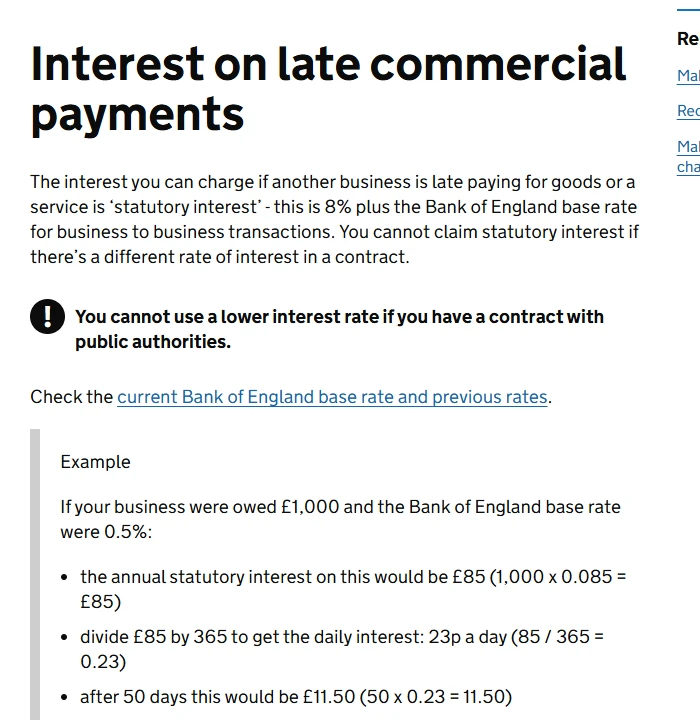
- United Kingdom: between businesses you can charge statutory interest of 8% a year plus the Bank of England base rate, unless the contract sets a different rate. With no agreed payment date, a payment is late 30 days after the customer gets the invoice or after you deliver the service, whichever is later. You can also claim debt recovery costs on top of the interest.
- European Union: in transactions between businesses, including sole traders working on their own account, interest becomes payable automatically 30 calendar days after the client receives the invoice if no date was agreed, and you can claim a flat 40 euros of compensation for each late invoice, more in some countries. The statutory rates for the second half of 2026 include 10.52% in Germany, 12.40% in France and 10.40% in Spain. None of this applies to private consumers.
- United States: no single national rule; it varies by state and city. New York City's rules are in section 7.
Whether any of these statutory rights reach you, working from outside the UK or the EU, depends on which law the contract names, and it gets murky when the contract names none. The dependable fix is to put three things in your own contract and invoice: payment terms (for example 15 days from the invoice), a late rate (1% to 1.5% a month is a common choice), and a line saying work pauses once an invoice is a set number of days overdue. Written down in advance, it gives the third email something to stand on, and the client cannot call it a surprise surcharge.
05When to stop working for them
If you still have no firm payment date by day 14, pause new work for this client. Carrying on only grows the amount at stake while your leverage shrinks.
Say it early, in writing and calmly, for example: "Until invoice [#023] is settled, I am pausing work on [the next phase]. I will pick it up the day the payment arrives." Do not pull back work that was already delivered, and do not delete the client's files; moves like that can weaken your position if it turns into a dispute. Source files, licences or final versions you have not handed over yet can wait for the final payment, as long as the contract said so from the start. The guide on deposits and milestones shows how to word that.
06Platform jobs go through the platform
For work won on Upwork, Fiverr and similar sites, chasing follows the platform's own process: how escrow is released, what to do when a client never approves the work, how a dispute is escalated. The terms of service cover all of it, and only for payments made through the platform. Money paid to you on the side is mostly beyond its reach.
That is why the offer to watch for on a platform job is "let me pay you directly this time and we both save the fee". Say yes, and the payment has left the platform's protection; if it goes late, you are chasing it alone. Many platforms also forbid taking payment off-platform in their terms, and getting caught can cost you the account.
07What the law where your client is can do
Suing across borders over a few hundred or a few thousand dollars rarely pays off: you need a local lawyer, you may need to appear in court, and a judgment still has to be enforced where the client is. The routes that actually get used are the cheap ones:
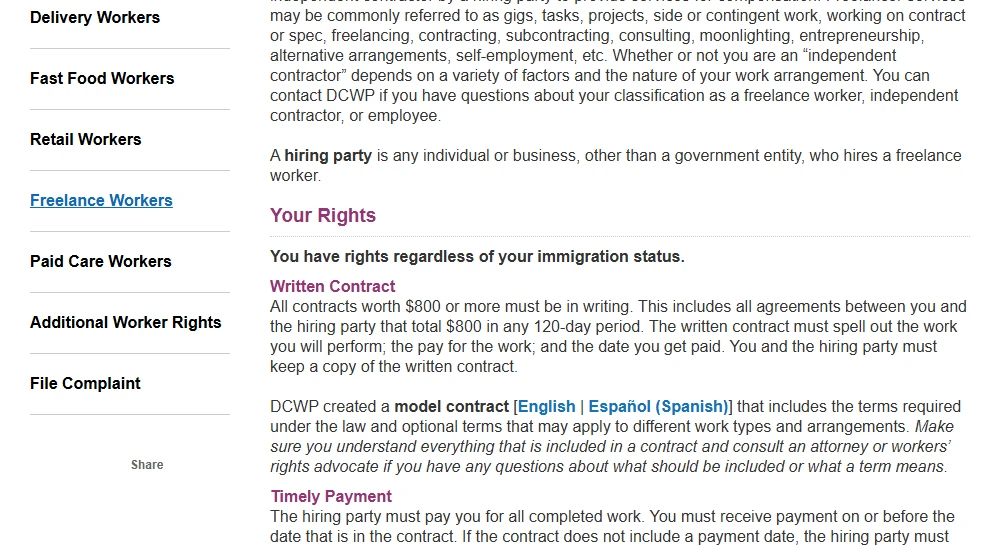
- A client in New York City: the city's Department of Consumer and Worker Protection (DCWP) enforces the Freelance Isn't Free Act. Work worth $800 or more needs a written contract setting out the work, the pay and the payment date. With no date in the contract, the client must pay within 30 days of you finishing the work, and if they don't pay on time you can claim double the unpaid amount plus attorneys' fees. Complaints can be filed online with DCWP, and the hiring party has 20 days to respond. The page does not say how far the law reaches freelancers based abroad, so ask DCWP before relying on it.
- A client in the UK: GOV.UK runs a process for making a court claim for money, and smaller claims can be made online. Whether you can use it from outside the UK, and what you would need, depends on the case.
- A client in the EU: the European Small Claims Procedure exists for exactly this kind of small cross-border debt.
- A commercial collection agency: it takes a percentage of whatever it recovers, and not a small one, so it suits larger amounts owed by a client that is still trading normally.
08When the money isn't coming back
By day 60, if the client still neither pays nor names a date, do the sum: the time and money it would take to keep going, set against the amount owed. If it is worth it, put the contract, the invoice, the delivery records and every email into one folder and hand it to a collection agency or a lawyer. If it isn't, send one last email stating that you reserve the right to recover the debt, and put your energy into the next job.
Letting go does not mean pretending it never happened. Record the bad debt on its own line in your books; how it is treated for tax depends on where you live, and the records guide shows how to log it. For the next client, a deposit, staged payments and an invoice that states the due date and the late terms will save far more effort than chasing ever will.
09FAQ
The client promised to pay next Monday, then didn't. Now what?
Put the date they gave you into your next email and ask them to confirm it in writing. If they miss it again, move to the next step on your schedule instead of waiting for another promise.
I never signed a contract, only exchanged messages. Can I still chase the money?
Yes. Messages, emails, delivered files and the invoice together still show that you agreed on the work and the fee. Without a written agreement, though, the payment deadline and any late interest mostly fall back on the default rules where the client is.
Can I name the client publicly on social media?
It is not a good idea. A public accusation can invite a defamation claim, and it makes a client who might have paid less willing to cooperate. Use written reminders and formal channels first.
The client offers to pay if I take a discount. Should I accept?
That depends on where your cut-off point is. Part of the money beats none, but put in writing that the reduced payment settles the invoice, and confirm only once the money has actually arrived.
Do I have to charge the late interest?
No. Its main job is to show the client that delay has a cost. If they pay the principal by your deadline, whether to waive the interest is up to you.
10What to read next
- GOV.UK: When a payment becomes late
- GOV.UK: Interest on late commercial payments
- Your Europe: B2B late payments
- NYC Department of Consumer and Worker Protection: Freelance Workers
EU statutory rates are reset every six months; check the period shown on the page before quoting one.